January
 
2015
| Publications

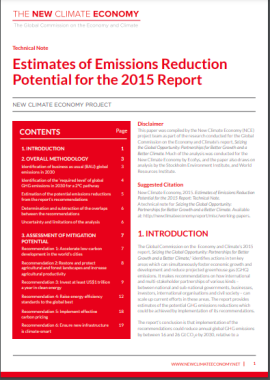
This paper documents the assumptions and analysis that underlie the presentation and discussion of the exhibit on the Global GHG Abatement Benefit and Co-benefit Curve: 2030 in our 2014 Better Growth, Better Climate report. This analysis emphasises the importance of considering a fuller range of benefits of actions to reduce carbon emissions when comparing these with higher-carbon alternatives.

Downloads

Title Size Action
Seizing the Global Opportunity: Partnerships for Better Growth and a Better Climate – Executive Summary

671.88 KB

NCE 2015 Resumen Ejecutivo

1.2 MB

Menangkap Peluang Global: Kemitraan Untuk Pertumbuhan Dan Iklim Yang Lebih Baik – Laporan Ekonomi Iklim Baru 2015

459.69 KB

Title Size Action
Seizing the Global Opportunity: Partnerships for Better Growth and a Better Climate.

5.38 MB

Menangkap Peluang Global: Kemitraan Untuk Pertumbuhan Dan Iklim Yang Lebih Baik – Laporan Ekonomi Iklim Baru 2015

6.21 MB

Title Size Action
Quantifying the multiple benefits from low-carbon actions in a greenhouse gas abatement cost curve framework

322.96 KB

|
Country
|
Publication Type

Related Content

The New Climate Economy launched its China research at the 2014 Annual Review of Low Carbon Development in China, hosted by its research partner Tsinghua University. Professor He Jiankun, Director, Institute of Energy, Environment and Economics, was encouraged by the potential of the research and remarked “I believe the New Climate Economy will make breakthroughs.”

Helen Mountford, Programme Director of the New Climate Economy project welcomed the announcements by China and the United States on their plans to tackle carbon pollution. The targets set by the United States and China, the world’s two largest emitters of greenhouse gases, send a signal to the world about the scale and size of opportunities in global markets for low carbon goods and services.

New research from the New Climate Economy shows that raising energy efficiency standards in the G20 and around the world could reduce greenhouse gas emissions by up to 6.9 Gt CO2e per year by 2030, more than the current annual emissions of the United States. These emissions reductions would be accompanied by economic savings in appliances, buildings, industry, and transport.

This paper is a background review representing part of the initial phase of the Financing the Urban Transition work programme. The review builds on a growing body of research that highlights both the importance of national sustainable infrastructure and the need to develop more effective and efficient financing mechanisms for delivering compact, connected cities that meet the UN’s Sustainable Development Goals. While progress has been made in both these areas over the last five years, there remains a policy gap between the international/national level and the municipal level.

China can achieve economic development, energy security and reduce pollution at the same time, according to a major study conducted by Tsinghua University in collaboration with the Global Commission. The report explains how China can face its development and climate challenges while maintaining growth of up to 7-8% in the near-term and 5% by 2030.