This website has been archived. Visit wri.org to learn more about continuing work under World Resources Institute’s Climate, Economics and Finance Programme.

Home
Menu

Main menu

  • Home
  • About us
  • Our Work
    • Country Programmes
    • Publications
    • Green Economic Modelling
  • News
  • Contact Us

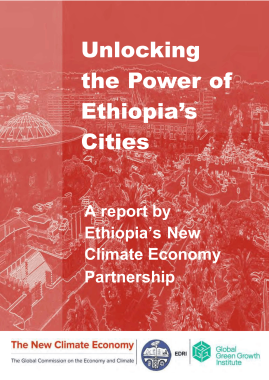
Unlocking the Power of Ethiopia’s Cities

Working Papers |
2015
| Ethiopia

Ethiopia has recognised the critical role that well-managed urbanisation will play in realising its ambition to achieve middle income status by 2025. Given the extended lifecycle of urban infrastructure, a small number of key decisions over the next five years will shape and lock in Ethiopia’s urban future for many decades to come. 

  • Read more about Unlocking the Power of Ethiopia’s Cities

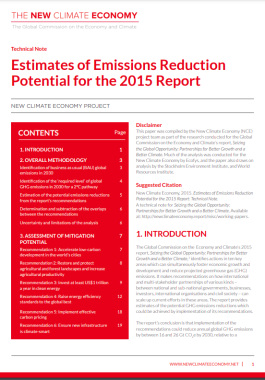
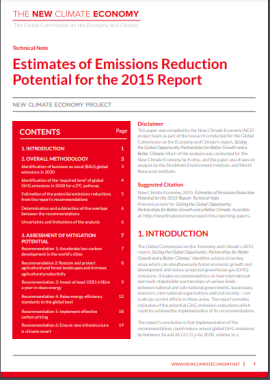
Estimates of Emissions Reduction Potential for the 2015 Report

GEM Technical Papers |
2015
| Global

This technical note sets out the analysis underpinning the emission reduction recommendations of the Global Commission on the Economy and Climate’s 2015 report. It explains baseline scenarios and the estimate of the emissions required for a 2C pathway.

  • Read more about Estimates of Emissions Reduction Potential for the 2015 Report

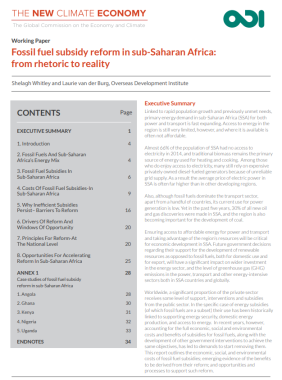
Fossil Fuel Subsidy Reform in sub-Saharan Africa: From Rhetoric to Reality

Working Papers |
2015
| Global

The costs of fossil fuel subsidies far outweigh the benefits when considering the full economic, social, and environmental impact of these subsidies in sub-Saharan Africa. If done right, phasing out fossil fuel subsidies in sub-Saharan Africa will lower greenhouse gas emissions, reduce air pollution, and create the fiscal space to provide access to energy and meet social development objectives. 

  • Read more about Fossil Fuel Subsidy Reform in sub-Saharan Africa: From Rhetoric to Reality

Quantifying the Multiple Benefits from Low-Carbon Actions in a Greenhouse Gas Abatement Cost Curve Framework

GEM Technical Papers |
2015
| Global

This paper documents the assumptions and analysis that underlie the presentation and discussion of the exhibit on the Global GHG Abatement Benefit and Co-benefit Curve: 2030 in our 2014 Better Growth, Better Climate report. This analysis emphasises the importance of considering a fuller range of benefits of actions to reduce carbon emissions when comparing these with higher-carbon alternatives.

  • Read more about Quantifying the Multiple Benefits from Low-Carbon Actions in a Greenhouse Gas Abatement Cost Curve Framework

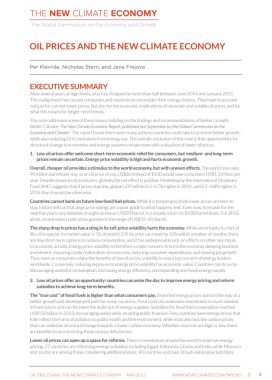
Oil Prices and The New Climate Economy

Working Papers |
2015
| Global

After several years at high levels, oil prices dropped by more than half between June 2014 and January 2015, leading many to ask questions about the implications for the economy and for countries’ and companies’ energy choices. Although such price swings have happened before, the issues being discussed are indeed quite important. 

  • Read more about Oil Prices and The New Climate Economy

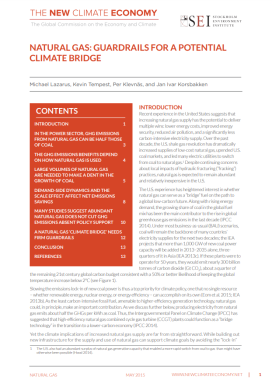
Natural Gas: Guardrails for a Potential Climate Bridge

Working Papers |
2015
| Global

This analysis weighs the potential benefits and risks of relying on expanded natural gas expansion and use as a “bridge” to a lower-carbon energy future, based on a review of the research literature and of recent modelling studies, as well as interviews with sector experts. It also examines the extent to which natural gas could play such a role, and the conditions that would be required. 

  • Read more about Natural Gas: Guardrails for a Potential Climate Bridge

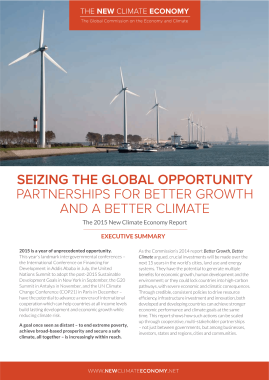
Seizing the Global Opportunity: Partnerships for Better Growth and a Better Climate

Global Reports |
2015
| Global

Momentum for a low-carbon economy is building, but much more needs to be done. International partnerships can help catalyse the economic growth and emissions reduction to get us there. The Global Commission makes 10 key recommendations in which partnerships can help deliver better growth and a better climate. 

  • Read more about Seizing the Global Opportunity: Partnerships for Better Growth and a Better Climate

Raising Ambition to Reduce International Aviation and Maritime Emissions

Working Papers |
2015
| Global

Global aviation and shipping together produce about 5% of global CO2 emissions, and by 2050 this is expected to rise to 10–32%. Yet these sectors offer some of the most cost-effective emission reductions available today, particularly through improved fuel efficiency. The Global Commission on the Economy and Climate recommends that emissions from the international aviation and maritime sectors be reduced in line with a 2°C pathway through action under the International Civil Aviation Organization (ICAO) and the International Maritime Organization (IMO). 

  • Read more about Raising Ambition to Reduce International Aviation and Maritime Emissions

Infrastructure Investment Needs of a Low-Carbon Scenario

Working Papers |
2014
| Global

This note describes the Commission’s assessment of future infrastructure investment needs. It presents projections for a baseline scenario, and the estimated incremental investment required for a low-carbon scenario. It sets out the sources used and provides an overview of the estimates and modelling undertaken by the New Climate Economy (NCE) network. 

  • Read more about Infrastructure Investment Needs of a Low-Carbon Scenario

China and the New Climate Economy

Case study |
2014
| China

This case study was conducted and written by NCE partner Tsinghua University. It shows how China can achieve economic development, energy security and reduce pollution at the same time.

  • Read more about China and the New Climate Economy

Pagination

  • First page « First
  • Previous page ‹‹
  • Page 1
  • Page 2
  • Current page 3
  • Page 4
  • Next page ››
  • Last page Last »
Subscribe to Low-carbon Development

Footer Menu

  • About us
  • News
  • Contact us
  • Country Programmes
  • Publications
  • Green Economy Model

Follow us

  • LinkedIn
  • Twitter

footer logo


© New Climate Economy |   Privacy Policy

  • Home
  • About us
  • Our Work
    • Country Programmes
    • Publications
    • Green Economic Modelling
  • News
  • Contact Us