This website has been archived. Visit wri.org to learn more about continuing work under World Resources Institute’s Climate, Economics and Finance Programme.

Home
Menu

Main menu

  • Home
  • About us
  • Our Work
    • Country Programmes
    • Publications
    • Green Economic Modelling
  • News
  • Contact Us

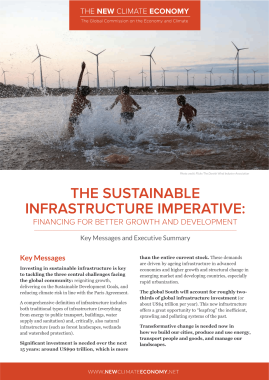
The Sustainable Infrastructure Imperative: Financing for Better Growth and Development

Global Reports |
2016
| Global

Investing in sustainable infrastructure is key to tackling the three central challenges facing the global community: reigniting growth, delivering on the Sustainable Development Goals, and reducing climate risk in line with the Paris Agreement. Transformative change is needed now in how we build our cities, produce and use energy, transport people and goods, and manage our landscapes. And the challenge is urgent. 

  • Read more about The Sustainable Infrastructure Imperative: Financing for Better Growth and Development

Financing the Urban Transition for Sustainable Development: Better Finance for Better Cities

Working Papers |
2016
| Global

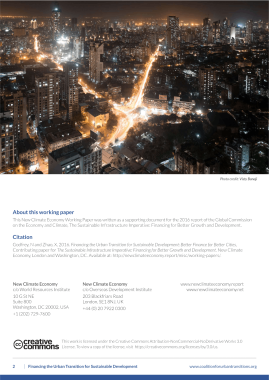
In urban infrastructure the investment decisions taken today will shape tomorrow. Despite the critical importance of infrastructure for urban development, financing to scale up smarter, more sustainable urban infrastructure remains an immense challenge, particularly in emerging and developing economies. 

  • Read more about Financing the Urban Transition for Sustainable Development: Better Finance for Better Cities

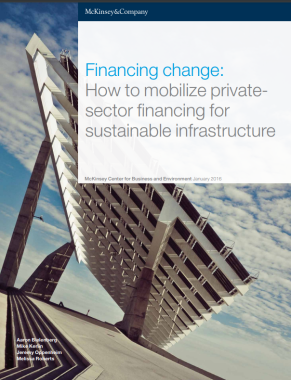
Financing Change: How to Mobilize Private Sector Financing for Sustainable Infrastructure

Working Papers |
2016
| Global

After the Paris agreement, many countries are looking to scale their investment in infrastructure that is socially inclusive, low carbon, and climate resilient. The huge quantity of investment required means that establishing the right conditions to attract private-sector investment is critical. In this paper by the McKinsey Center for Business and Environment, the authors highlight the major barriers that must be overcome and the ways to encourage more capital investment in sustainable infrastructure. The paper determines that a “muscular set of nudges and risk-sharing instruments are required”. 

  • Read more about Financing Change: How to Mobilize Private Sector Financing for Sustainable Infrastructure

Galvanising low-carbon Innovation

Working Papers |
2016
| Global

Innovation is a fundamental engine of long-term economic growth, and a critical driver for reducing emissions and tackling climate risk. There is a need to scale up innovation efforts to reduce emissions cost-effectively beyond 2030 consistent with limiting dangerous climate change, in particular through supporting research, development and demonstration (RD&D) for technologies which have not yet been deployed at scale and are unlikely to without strong government support. 

  • Read more about Galvanising low-carbon Innovation

Investing at Least a Trillion Dollars a Year in Clean Energy

Working Papers |
2016
| Global

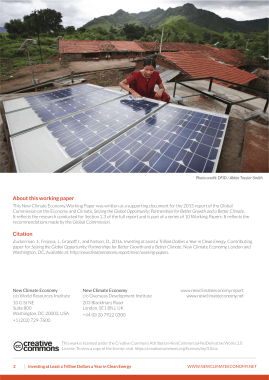
Energy demand is projected to grow by a third in the next 15 years. A rapid scale-up of low-carbon energy sources and energy efficiency is essential to drive global growth, reduce the air pollution and greenhouse gas emissions (GHGs) associated with fossil fuel use and help provide reliable access to modern energy for those who lack it. This need has become more urgent following the global commitment made in the UN Paris Agreement in December 2015 to reducing net GHG emissions to zero in the second half of the century. 

  • Read more about Investing at Least a Trillion Dollars a Year in Clean Energy

Natural Gas: Guardrails for a Potential Climate Bridge

Working Papers |
2015
| Global

This analysis weighs the potential benefits and risks of relying on expanded natural gas expansion and use as a “bridge” to a lower-carbon energy future, based on a review of the research literature and of recent modelling studies, as well as interviews with sector experts. It also examines the extent to which natural gas could play such a role, and the conditions that would be required. 

  • Read more about Natural Gas: Guardrails for a Potential Climate Bridge

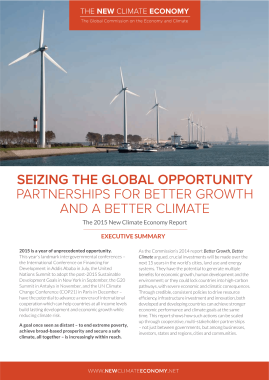
Seizing the Global Opportunity: Partnerships for Better Growth and a Better Climate

Global Reports |
2015
| Global

Momentum for a low-carbon economy is building, but much more needs to be done. International partnerships can help catalyse the economic growth and emissions reduction to get us there. The Global Commission makes 10 key recommendations in which partnerships can help deliver better growth and a better climate. 

  • Read more about Seizing the Global Opportunity: Partnerships for Better Growth and a Better Climate

Raising Ambition to Reduce International Aviation and Maritime Emissions

Working Papers |
2015
| Global

Global aviation and shipping together produce about 5% of global CO2 emissions, and by 2050 this is expected to rise to 10–32%. Yet these sectors offer some of the most cost-effective emission reductions available today, particularly through improved fuel efficiency. The Global Commission on the Economy and Climate recommends that emissions from the international aviation and maritime sectors be reduced in line with a 2°C pathway through action under the International Civil Aviation Organization (ICAO) and the International Maritime Organization (IMO). 

  • Read more about Raising Ambition to Reduce International Aviation and Maritime Emissions

Implementing Effective Carbon Pricing

Working Papers |
2015
| Global

Strong, predictable and rising carbon prices send an important signal to markets and can reduce greenhouse gas emissions without harming the economy. Around 40 national jurisdictions and over 20 cities, states and regions, have adopted or are planning explicit carbon prices, covering about 12% of global GHG emissions.

  • Read more about Implementing Effective Carbon Pricing

Driving Sustainable Development Through Better Infrastructure: Key Elements of a Transformation Program

Working Papers |
2015
| Global

This report finds that growth strategies which fail to tackle poverty or climate change will prove to be unsustainable, and vice versa. A common denominator to the success of both agendas is infrastructure development. 

  • Read more about Driving Sustainable Development Through Better Infrastructure: Key Elements of a Transformation Program

Pagination

  • First page « First
  • Previous page ‹‹
  • Page 1
  • Current page 2
  • Page 3
  • Page 4
  • Next page ››
  • Last page Last »
Subscribe to Low-carbon Development

Footer Menu

  • About us
  • News
  • Contact us
  • Country Programmes
  • Publications
  • Green Economy Model

Follow us

  • LinkedIn
  • Twitter

footer logo


© New Climate Economy |   Privacy Policy

  • Home
  • About us
  • Our Work
    • Country Programmes
    • Publications
    • Green Economic Modelling
  • News
  • Contact Us