December
 
2014
| Publications

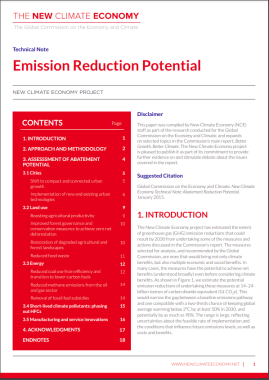
The New Climate Economy project has estimated the extent of greenhouse gas (GHG) emission reductions that could result by 2030 from undertaking some of the measures and actions discussed in our 2014 annual report Better Growth, Better Climate. We estimate the potential emission reductions of undertaking these measures that would narrow the gap between a baseline emissions pathway and one compatible with a two-thirds chance of keeping global average warming below 2°C by at least 50% in 2030

Downloads

Title Size Action
Better Growth, Better Climate: Executive Summary

460.21 KB

Daha İyi Büyüme, Daha İyi İklim: Yönetici Özeti

7.34 MB

Une Meilleure Croissance, Un Meilleur Climate: Executive Summary

705.66 KB

Besseres Wachstum, Besseres Klima: Zusammenfassung

725.84 KB

Mejor Crecimiento, Mejor Clima: Resumen Ejecutivo

324.68 KB

Crescita Migliore, Clima Migliore: Executive Summary

902.91 KB

Pertumbuhan Lebih Baik Iklim Lebih Baik: Ringkasan Eksekutif

859.04 KB

Title Size Action
新しい気候経済 統合報告書

7.68 MB

应对气候变化, 孕育经济增长: 统整报告

3.64 MB

Better Growth, Better Climate: Synthesis Report

3 MB

국문번역본

1.44 MB

UNE MEILLEURE CROISSANCE, UN MEILLEUR CLIMAT

2.8 MB

УЛУЧШЕННЫЙ РОСТ, УЛУЧШЕННЫЙ КЛИМАТ: СВОДНЫЙ ОТЧЕТ

2.13 MB

Better Growth, Better Climate: Laporan Sintesis

3.48 MB

Mejor Crecimiento, Mejor Climate: Síntesis del informe

3.54 MB

Title Size Action
Global Report

10.28 MB

Overview — Strategic Context

3.31 MB

Chapter 2 — Cities

983.99 KB

Chapter 3 — Land Use

5.92 MB

Chapter 4 — Energy

2.24 MB

Chapter 5 — Economics of Change

1.04 MB

Chapter 6 — Finance

8.49 MB

Chapter 7 — Innovation

2.04 MB

Chapter 8 — International Cooperation

2.66 MB

Global Action Plan

111.69 KB

Title Size Action
China and the New Climate Economy: Executive Summary

2.55 MB

中国与 新气候经济

5.8 MB

Unlocking the power of Ethiopia’s cities

4.08 MB

India: Pathways to sustaining rapid development in a new climate economy

2.04 MB

Seeing Is Believing: Creating a New Climate Economy in the United States (Summary)

570.48 KB

Seeing Is Believing: Creating a New Climate Economy in the United States

3.54 MB

Title Size Action
Emissions Reduction Potential

838.63 KB

Research Programme
|
Country
|
Publication Type

Related Content

A study by the World Resources Institute (WRI) identifies many real-world examples where government policies and sustained technological progress in the United States are creating opportunities to reduce greenhouse gas emissions, while delivering net economic benefits. "Business leaders are waking up to this reality and it’s time for more U.S. elected officials to do the same,” said Andrew Steer, President and CEO, WRI.

Chair of the Global Commission on the Economy and Climate Felipe Calderón joined Buenos Aires Mayor Mauricio Macri and Mexico City Mayor Miguel Ángel Mancera in announcing both the C40 City Bus Declaration of Intent and a Latin American Cities Declaration on the Compact of Mayors.

A new paper from the New Climate Economy shows there is large untapped potential for fuel efficiency gains in both aviation and shipping sectors that would cut costs and reduce emissions. International aviation and shipping have grown dramatically in the last few decades along with their emissions: aviation and shipping now produce 5% of global CO2 emissions, and by 2050, that share could rise to as much as 32%. Much of the potential to reduce emissions in aviation and shipping can be unlocked through existing technologies and practices that leading companies in each sector have already embraced. However, as this new paper shows, market failures and political barriers are hindering progress.

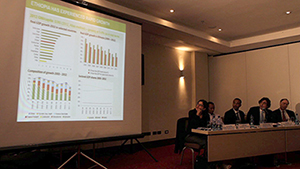
Former President Felipe Calderon launched the New Climate Economy's "Better Growth, Better Climate Report" in Mexico, along with Helen Mountford, Director of the New Climate Economy and María Amparo Martínez Arroyo, General Director of the National Institute of Ecology and Climate Change.

"We welcome this announcement and the fact that Mexico is the first major emerging economy to declare its commitment to a low-carbon future. This is an example for other countries, including developed countries, to follow,” former President Felipe Calderón and Chair of the Global Commission on the Economy and Climate said.

A new paper, Implementing effective carbon pricing, from the New Climate Economy shows that carbon pricing works and doesn’t harm the economy. It urges developed and emerging economies, with the G20 in the lead, to commit to introducing carbon prices of roughly comparable levels by 2020.

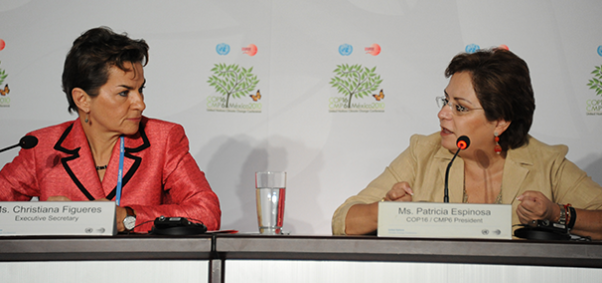
Today, UN Secretary-General Ban Ki-Moon nominated Mexican Ambassador Patricia Espinosa as the next Executive Secretary of the UN Framework on Climate Change (UNFCCC). Former President of Mexico and Chair of the Global Commission on the Economy and Climate Felipe Calderón releases the following statement: